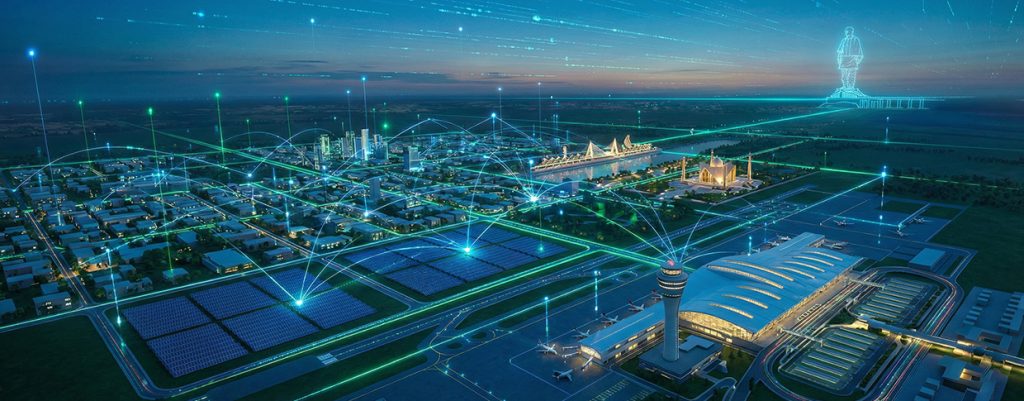
Urban planning is no longer about theory; it is about execution. As of February 2026, the Dholera Special Investment Region (DSIR) in Gujarat has transitioned from a blueprint on paper to a fully functioning industrial engine. Dholera offers India’s smart city researchers the first concrete example of how greenfield development can spur economic growth in the country.
With the Ahmedabad-Dholera Expressway now operational and the first phase of the International Airport entering its testing cycle, Dholera is proving that large-scale sustainable development is possible. This blog explores how recent milestones—from Tata’s semiconductor fab to Adani’s defense corridors—are setting new benchmarks for urban innovation, while also examining the broader success of India’s Smart Cities Mission (SCM).
The Semiconductor Revolution
The most significant shift in 2026 is Dholera’s emergence as India’s “Semicon City.” Smart city research in India often focuses on digital infrastructure, but Dholera has taken this a step further by manufacturing the hardware that powers it.
Tata Electronics & PSMC
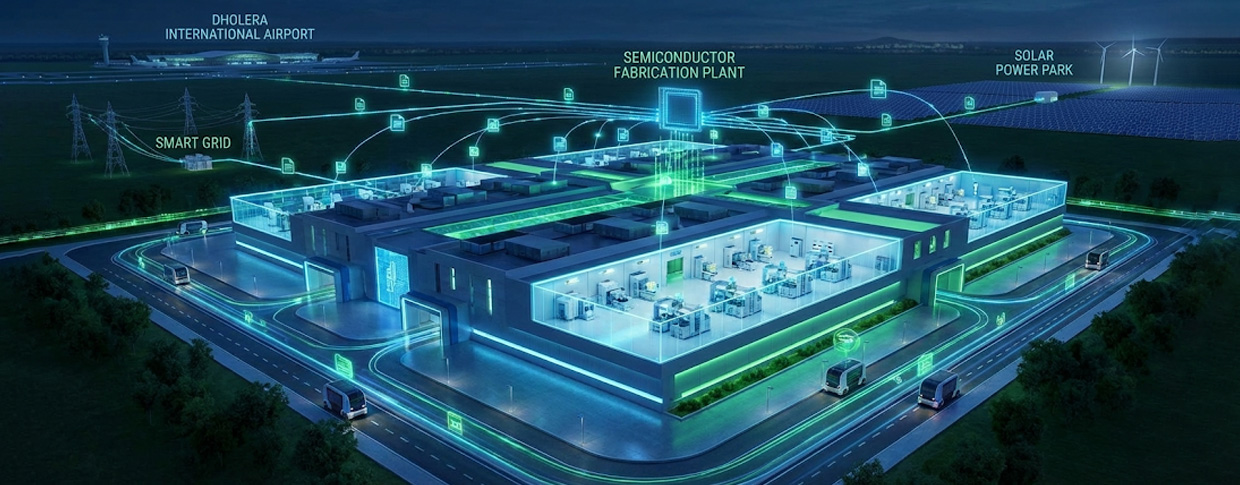
The Tata Electronics and PSMC semiconductor plant is rapidly approaching its first commercial production, targeted for late 2026. With an investment exceeding ₹91,000 Crore, this facility is not just a factory; it is a massive consumer of high-grade utilities.
-
Research Insight: Dholera’s “Plug-and-Play” infrastructure can support the ultra-stable power and water requirements of a fab, providing a breakthrough validation for industrial smart cities.
The Tillman Global Data Center
In January 2026, Tillman Global announced a massive $10 billion investment to establish data centers in Dholera. This move solidifies the city’s status as a digital storage hub, offering researchers real-world data on how edge computing integrates with urban governance.
What is the Main Goal of the Smart City Research in India?
While Dholera represents the pinnacle of greenfield projects, it is part of a larger narrative driven by the Government of India. Launched by Prime Minister Narendra Modi, the Smart Cities Mission (SCM) aimed to transform 100 cities into engines of economic growth.
The core objective was to drive economic growth and improve the quality of life of people by enabling local area development and harnessing technology, especially technology that leads to smart outcomes. The mission envisioned inclusive cities that provide core infrastructure and give a decent quality of life to their citizens, a clean and sustainable environment, and the application of ‘Smart’ Solutions.
The Union Ministry of Urban Development (now MoHUA) was instrumental in creating the policy framework. They moved away from a one-size-fits-all approach, allowing cities to formulate their own unique smart city proposal. This decentralization meant that Dholera could focus on industrial utility tunnels, while other cities focused on basic retrofitting. The mission introduced a unique governance model where each city created a Special Purpose Vehicle (SPV). The SPV, headed by a CEO, plans, appraises, approves, releases funds, implements, manages, operates, monitors, and evaluates the Smart City development projects.
India’s Urbanization Landscape: From Statutory Towns to Smart Cities
To understand the magnitude of this mission, one must look at the demographics. India has a vast number of statutory towns, yet the pressure on major urban areas has been immense. The SCM was designed to alleviate this pressure by creating counter-magnets in metropolises like Delhi and Mumbai.
Transforming Parts of the City and Rural Areas
Most projects under the SCM focused on Area-Based Development (ABD). This involved targeting specific parts of the city for retrofitting or redevelopment. For example, in Bhopal or Indore, specific districts were chosen to be “smart,” serving as a lighthouse for the rest of the city. While the mission focused on urban areas, the ripple effect was designed to benefit rural areas as well. By creating economic hubs in Tier-2 and Tier-3 cities, the program aimed to reduce distress migration from villages to already choked metros. Dholera, located between Ahmedabad and Bhavnagar, serves as a perfect example of urbanizing a previously rural landscape to create high-value jobs.
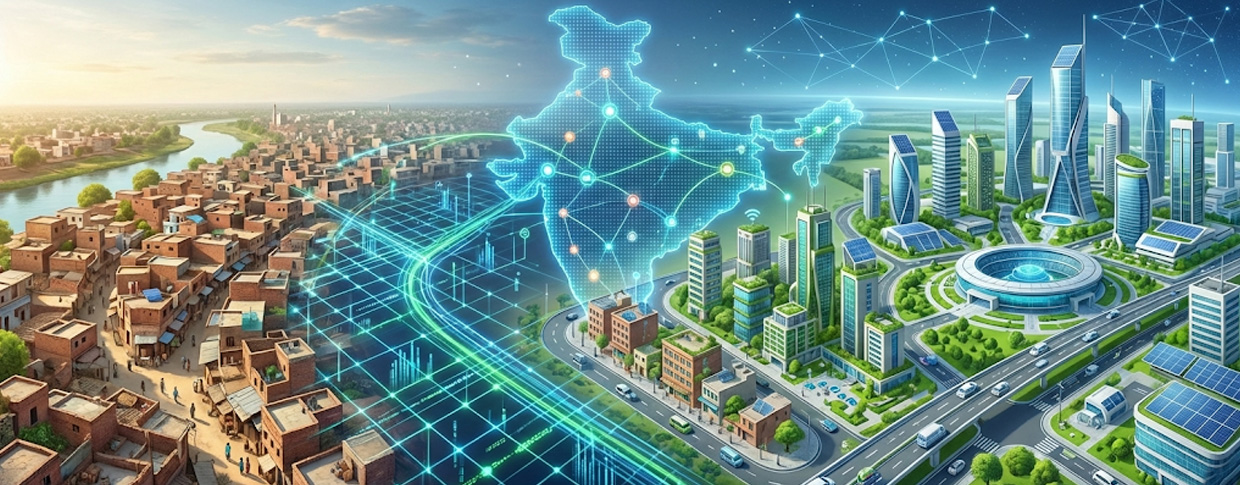
Financing the Vision: Investments worth Rs 1 Lakh Crore
One of the most discussed aspects of smart city research in India is financing. The financial magnitude of the SCM is unprecedented in India’s history.
Central and State Government Contributions
The mission operated as a Centrally Sponsored Scheme (CSS). The Central Government proposed to give financial support to the Mission to the extent of Rs 48,000 Crore over five years. The State/ULB was required to contribute a matching amount. This created a total funding pool of nearly Rs 1 lakh Crore from government sources alone.
Leveraging Public-Private Partnerships
However, government grants were only the seed. The real success came from convergence and PPPs. By 2026, the total investment in the mission had crossed Rs 1.7 lakh Crore, proving that private players are willing to invest in India’s urban future if the governance model is transparent.
Progress Report: Completion Deadlines and Media Analysis
Tracking the progress of such a massive program requires diligent monitoring. Deadlines have shifted, but the completion rate as of 2026 is impressive.
Reports from Times of India and Indian Express
Leading media houses have closely tracked the mission. As reported by the Times of India and the Indian Express, many projects faced a critical deadline of September 2024, which was later extended. These reports highlighted that while physical infrastructure (roads, bridges) was completed early, the digital layers (ICCCs, smart data centers) took longer to perfect. By February 2026, however, most of these hurdles will have been overcome.
Dholera vs. SCM: Greenfield Development vs. Retrofitting
A key distinction in smart city research in India is the difference between Dholera and the rest of the SCM cities.
The Challenge of Brownfield Projects
Most SCM projects, like those in Visakhapatnam, Chandigarh, or Amritsar, focus on local area development—improving existing areas (retrofitting) or redevelopment. They deal with the challenges of existing congestion, legacy infrastructure, and population density. Excavating roads in Delhi or Mumbai to lay smart sensors is logistically difficult.
The Advantage of Greenfield Development
Dholera is a greenfield development. It is built from scratch on barren land, allowing for perfect planning of underground utilities, water supply, and the solid waste management system before a single building was constructed. This makes Dholera a more “pure” smart city model compared to the retrofitting approach of Puducherry or Jammu.
Connectivity: Linking Delhi, Mumbai, and Dholera
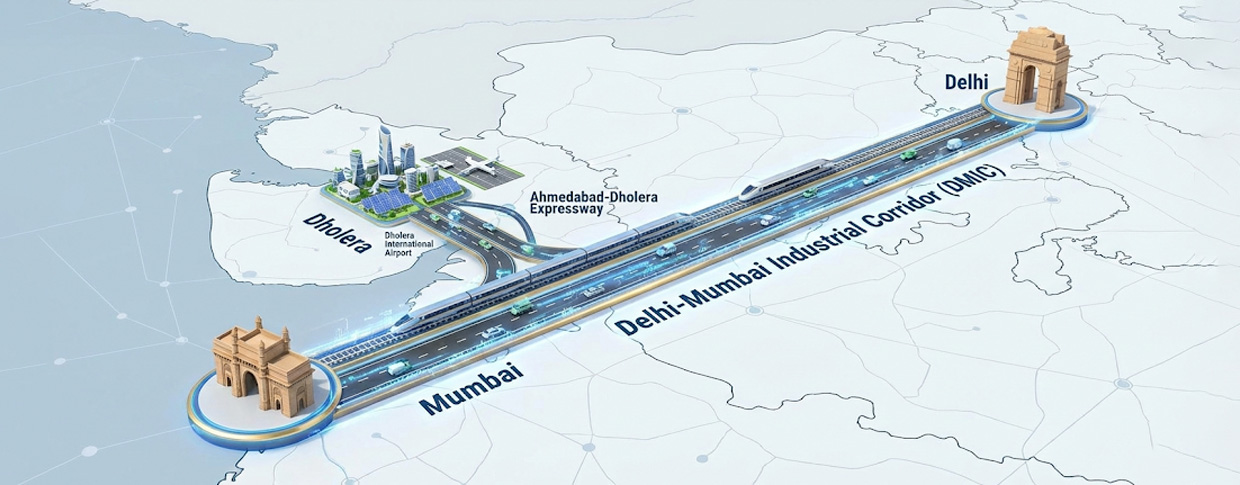
A critical metric in smart city research in India is “mobility efficiency.” February 2026 marks a turning point for the region’s logistics, linking Dholera to the major economic corridors of Delhi and Mumbai.
Expressway Operational Status
The opening of the 109-kilometer Ahmedabad-Dholera Expressway has reduced travel time to less than 50 minutes. This corridor effectively merges Dholera with the Ahmedabad economic zone. Furthermore, its alignment with the Delhi-Mumbai Industrial Corridor (DMIC) means goods manufactured in Dholera can reach the ports of Mumbai or the markets of Delhi in record time.
Airport Milestones
With the Dholera International Airport completing its Phase 1 construction in December 2025, the region is now preparing for cargo integration. This multi-modal connectivity (Road, Air, and Rail) allows for a seamless “factory-to-flight” logistics chain.
International Collaboration: How Do Indian Smart Cities Compare?
India’s smart cities have actively sought international benchmarks and partnerships to ensure world-class standards.
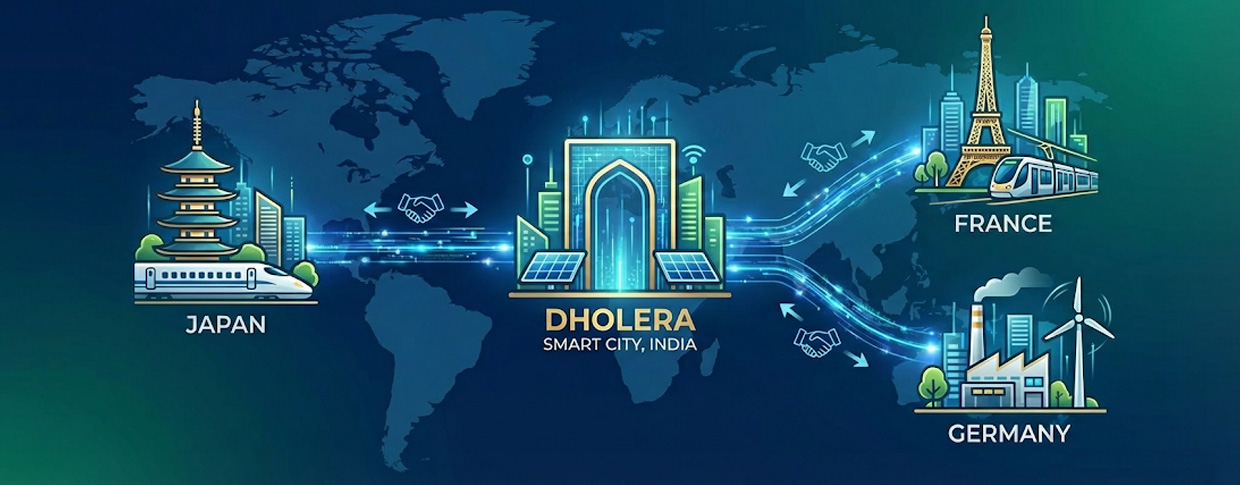
Lessons from Japan, France, and Germany
-
Japan: Japan has been a key partner, specifically in the development of the Visakhapatnam, Ahmedabad, and the Chennai-Bengaluru Industrial Corridor (CBIC).
-
France: France has collaborated to develop Chandigarh, Puducherry, and Nagpur, bringing expertise in sustainable urban mobility.
-
Germany: Germany has supported projects in Bhubaneswar, Kochi, and Coimbatore, focusing on sustainable transport and energy efficiency.
These partnerships ensure that cities like Dholera and those in Telangana and Andhra Pradesh are not just competing locally but are aligned with the global standards of Japan, Germany, and France.
Challenges Facing Smart City Projects in India
Despite the successes, smart city research in India highlights several hurdles that the SCM has faced:
Capacity Building in Urban Local Bodies
Many Urban Local Bodies (ULBs) lacked the technical expertise to manage complex digital systems. Capacity-building programs were launched to train municipal officials. Without this training, the expensive digital dashboards in the ICCCs would remain unused.
Financial Sustainability and Land Issues
While the Central Government provided seed funding, generating the remaining funds through Public-Private Partnerships (PPP) was a challenge for smaller towns in the West Bengal CM jurisdiction or Kashmir. Ensuring the SPVs can generate their revenue post-mission is the next big challenge. Additionally, for greenfield projects, acquiring land remains a sensitive and time-consuming process. While Dholera successfully managed the situation through land pooling, other projects across India faced delays due to litigation and protests from local communities.
Sustainability and The “Living Lab” Concept
Dholera acts as a living laboratory for sustainable urban development. The Integrated Command and Control Centre (ICCC) manages the city’s governance.
Renewable Energy Integration
The massive Solar Park is now feeding the grid. This is crucial for India’s commitment to reducing carbon footprints. Green energy powers the industries in Dholera, providing a significant advantage for global exports.
Advanced Water Security
Water is a scarce resource in India. Dholera’s advanced recycling and desalination networks ensure that the semiconductor and heavy industries do not deplete local water tables. This model is now being studied for replication in other water-stressed regions like Solapur and Chennai.
Conclusion: Smart City Research in India
The year 2026 has silenced the skeptics. Dholera is no longer an experiment; it is an operational success story. The city is paving the way for the future by welcoming global tech giants and initiating aircraft manufacturing.
For investors, policymakers, and academics, the message is clear: To understand the future of smart city research in India, look no further than Dholera. The successful completion of major infrastructure projects by September 2025 and early 2026 has cemented its place on the global map.
How have smart cities impacted urban life in India?
Smart cities have significantly improved quality of life by integrating technology into governance. For example, ICCCs (Integrated Command and Control centers) have reduced crime rates and improved traffic management in cities like Surat and Pune. Smart water meters and solid waste management systems have ensured better hygiene and resource utilization.
What rules are in place to help India build smart cities?
The Ministry of Urban Development releases the Smart Cities Mission guidelines, which guide the development process. Key policies include the requirement for an SPV (Special Purpose Vehicle) to execute projects, the emphasis on Area-Based Development (ABD), and the convergence with other schemes like AMRUT (for water and sewerage) and the Swachh Bharat Mission.
Smart City Research in India has evolved into a dynamic field, marked by innovative solutions and collaborative efforts across multiple sectors. The success story of Dholera serves as a beacon for other regions aiming to address urban challenges through technological integration. With infrastructure projects nearing completion, the city is not only redefining urban living but also attracting investments that promise economic growth and development.
Beyond Dholera, cities like Surat and Pune exemplify the transformative power of Smart City Research in India and its initiatives.
India’s developing smart cities’ main features?
Key features include:
-
Assured electricity supply and smart metering.
-
Adequate water supply and wastewater recycling.
-
The sanitation system also encompasses the management of solid waste.
-
The implementation of efficient urban mobility and public transport is also crucial.
-
The implementation of robust IT connectivity and digitalization is crucial.
-
Good governance, particularly e-Governance and citizen participation, is crucial.
-
Sustainable environmental practices.
What is the current status of smart city initiatives in major Indian cities?
As of 2026, major cities like Visakhapatnam, Chandigarh, and Indore have completed most of their proposed projects. The June 2024 deadline was extended, and by early 2026, over 90% of the projects across the 100 cities were operational. Cities in Andhra Pradesh and Telangana have shown remarkable progress in digital integration.
As India strides towards a more urban future, the Smart Cities Mission stands as a beacon of innovation and sustainability. Surat and Pune exemplify this journey, where smart water meters have revolutionized resource management, promoting not only efficiency but also hygiene. The adoption of solid waste management systems reflects a national commitment to cleanliness and environmental stewardship.
Guided by the Ministry of Urban Development, the Smart Cities Mission follows stringent guidelines designed to streamline development. The establishment of Special Purpose Vehicles (SPVs) ensures targeted project execution, while Area-Based Development (ABD) facilitates localized solutions tailored to specific urban challenges.